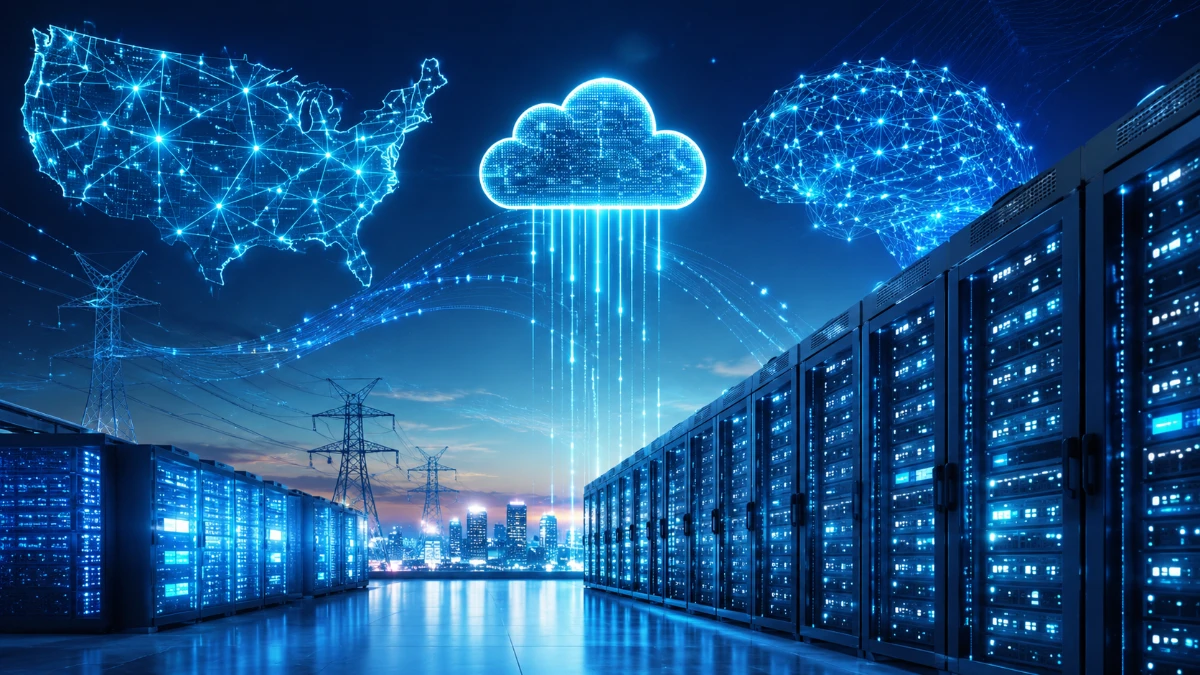
Data centers power everything from cloud storage and video streaming to artificial intelligence, but their rapid expansion is also creating new questions about electricity, water, land and local infrastructure.
When someone streams a movie, uploads a photo, joins a video meeting or asks an artificial intelligence assistant a question, the work does not happen only on the device in front of them.
Behind those services are data centers: specialized facilities filled with computers, storage equipment and networking systems that process and move digital information.
Data centers have supported the internet for decades. What is changing is their scale and importance. Cloud computing, online services and the rapid growth of artificial intelligence are increasing demand for computing capacity across the United States.
That expansion is turning data centers into a major part of the country’s physical infrastructure. Like factories, transportation networks and power plants, they require land, electricity, cooling systems, construction workers and connections to local utilities.
The result is a complicated tradeoff. More data centers can support innovation, employment and digital services, but poorly planned growth can also place pressure on electrical grids, water supplies and nearby communities.
What Is a Data Center?
A data center is a building or group of buildings designed to operate computer systems continuously.
Inside a typical facility are rows of servers that run applications, store files and process information. Data centers also contain networking equipment that connects those servers to users and other facilities.
The equipment depends on several supporting systems:
-
Electrical connections and backup power
-
Cooling and ventilation
-
Fire detection and suppression
-
Physical security
-
High-speed internet connections
-
Monitoring and maintenance systems
Data centers vary greatly in size. A business may operate a small room containing a limited number of servers, while a major cloud provider may run an enormous campus with multiple buildings.
Large facilities operated by companies such as Amazon, Google, Microsoft and Meta are often called hyperscale data centers. These sites are designed to handle very large computing workloads and serve users across multiple regions.
What Do Data Centers Actually Do?
Data centers support many services that people use every day.
They may process:
-
Search engine requests
-
Online shopping transactions
-
Streaming video and music
-
Cloud backups
-
Social media feeds
-
Banking applications
-
Business software
-
Online games
-
Email and messaging
-
Artificial intelligence workloads
When a user opens a cloud-based application, their device sends a request through the internet. A server inside a data center processes that request and sends the result back.
The process may take only a fraction of a second, but it can involve several networks, databases and computing systems.
A single online service may also use multiple data centers. This can improve performance and keep the service available if one facility experiences a technical problem.
Why Is America Building More Data Centers?
The United States is experiencing growth in several types of digital activity at the same time.
Consumers are storing more information online. Businesses are moving software and databases to cloud platforms. Video, gaming and communication services require extensive computing resources.
Artificial intelligence is adding another major source of demand.
Training and operating advanced AI models can require large clusters of specialized processors. These systems may use far more electricity than conventional business applications, particularly when they operate continuously at high utilization.
The International Energy Agency reported that global data-center electricity demand increased by 17 percent in 2025. Electricity consumption at AI-focused facilities grew even faster, according to the agency.
The expansion is not driven by AI alone. Manufacturing growth, transportation electrification and other economic changes are also raising U.S. electricity demand. However, the Department of Energy identifies data-center expansion and AI applications as important contributors to this broader increase.
Why Artificial Intelligence Requires So Much Infrastructure
An AI service may look simple from the user’s perspective. Someone enters a question and receives an answer within seconds.
Behind that interaction, however, a data center may be running a large model across multiple processors.
AI infrastructure usually supports two broad types of work.
Training
Training is the process of developing or improving a model using large amounts of data and computing power.
Advanced training runs may use thousands of specialized processors for extended periods. The equipment must exchange data quickly, which requires high-performance networking and storage.
Inference
Inference happens when a trained model responds to a user or performs a task.
Each individual request may require less computing power than training the model, but popular services can receive millions of requests. The combined workload can therefore become substantial.
AI companies are also developing systems that perform longer and more complicated tasks. These may involve multiple model calls, external tools and repeated processing steps.
Although processor efficiency continues to improve, the total amount of AI use is also increasing. This means greater efficiency does not automatically reduce overall electricity demand.
How Much Electricity Do U.S. Data Centers Use?
Data-center electricity use is difficult to predict because the industry is changing rapidly.
A 2025 update published by Lawrence Berkeley National Laboratory in June 2026 estimated that data centers could account for approximately 11.8 percent of total U.S. electricity consumption by 2030.
The report did not present that figure as a guaranteed outcome. Its range of scenarios placed the possible share between 9.5 and 15.3 percent, depending on factors such as deployment speed, hardware efficiency and workload growth.
These projections should be described carefully. They estimate possible future demand and are not measurements of current 2030 consumption.
The International Energy Agency has also projected that data centers could represent nearly half of the growth in U.S. electricity demand through 2030.
That does not mean data centers will use half of all electricity in the country. It means they could account for nearly half of the increase in demand over that period.
This distinction is important because headlines about data-center electricity use can easily become misleading when total demand and demand growth are confused.
Why Data Centers Need So Much Power
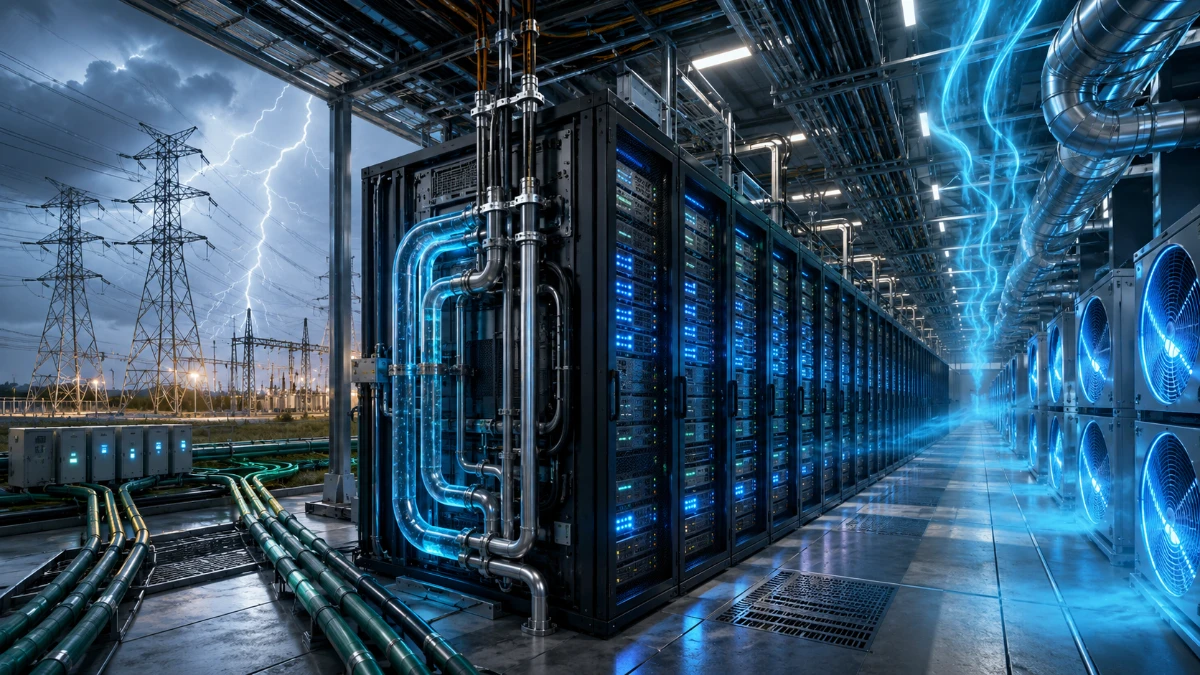
Servers consume electricity while performing calculations, storing data and moving information across networks.
Other equipment inside the facility also uses power, including:
-
Cooling systems
-
Pumps and fans
-
Storage devices
-
Network switches
-
Lighting and security systems
-
Backup power equipment
A data center must also provide power reliably. Even a brief interruption can disrupt services or damage operations.
Facilities may therefore use backup batteries and generators to maintain service during an outage. Some campuses also explore agreements with nearby energy projects or power plants.
The challenge is not only how much electricity a facility consumes over a year. A very large data center may request a substantial amount of power at one location and expect it to be available continuously.
A 2024 Department of Energy advisory noted that some proposed hyperscale facilities were seeking grid connections in the range of 300 to 1,000 megawatts or more. Requests of that size can be difficult for local grids to accommodate quickly.
Actual demand varies widely between facilities, and not every data center approaches that scale.
Where Does the Electricity Come From?
The electricity serving a data center normally comes from the regional power system, which may use several energy sources.
According to the International Energy Agency, natural gas currently provides more than 40 percent of the electricity used by U.S. data centers. Renewables provide approximately 24 percent, while nuclear power and coal supply smaller shares.
The mix differs by state and electricity market.
Technology companies also sign long-term agreements to purchase renewable or low-carbon energy. Such agreements can help finance new generation, but they do not necessarily mean that a facility is physically powered by one specific source every hour.
The electricity delivered to a facility usually reflects the resources available on the regional grid at that time.
As data-center demand grows, utilities and policymakers are considering several options:
-
New electricity generation
-
Expanded transmission lines
-
Energy storage
-
Grid upgrades
-
More efficient computing systems
-
Flexible operating schedules
-
On-site power generation
-
Improved coordination between developers and utilities
The Department of Energy says that a combination of grid investment, efficiency and demand flexibility may be needed to serve new facilities while maintaining reliability and affordability.
Why Cooling Is Essential
Computers turn part of the electricity they consume into heat.
When thousands of processors operate close together, the heat must be removed continuously. Excessive temperatures can reduce performance, shorten equipment life or cause systems to shut down.
Traditional data centers often rely heavily on air cooling. Fans move cool air toward the servers and carry hot air away.
High-density AI systems can produce more heat within a smaller space, which is encouraging greater use of liquid cooling.
Liquid can transfer heat more effectively than air. Depending on the design, cooling fluid may circulate through plates attached to processors or through systems positioned near server components.
Cooling systems can improve reliability, but they also add cost and complexity. Operators must consider leaks, maintenance, water availability, local climate and compatibility with existing equipment.
Do Data Centers Use Water?
Some data centers use water directly in cooling systems. Others depend more heavily on air cooling or closed-loop systems.
Water use depends on several factors:
-
Facility design
-
Climate
-
Cooling technology
-
Server density
-
Time of year
-
Local water availability
-
Source of electricity
Even when a facility uses little water directly, the power plants supplying its electricity may consume water.
This makes water impact difficult to summarize with a single number.
A data center in a cool climate may have different requirements from one in a hot and dry region. A facility using reclaimed water may also have a different effect than one relying on drinking-water supplies.
Companies should therefore report local water use and cooling practices clearly rather than relying only on global totals.
Why Location Matters
Data centers cannot be built effectively in every location.
Developers typically look for access to:
-
Reliable and affordable electricity
-
High-capacity internet connections
-
Suitable land
-
Water or other cooling resources
-
Construction workers
-
Low risk of certain natural hazards
-
Supportive zoning and permitting
-
Proximity to users or business customers
Latency is also important. Latency is the delay between a user sending a request and receiving a response.
Some applications can operate from a distant data center without noticeable problems. Others, including online gaming, financial services and real-time communication, may perform better when computing resources are closer to users.
For this reason, the industry includes both enormous centralized campuses and smaller regional facilities.
How Can Data Centers Benefit Local Communities?
Data-center projects can bring several economic benefits.
Construction requires workers, equipment and local services. Once operating, facilities employ technicians, security personnel, engineers, managers and maintenance teams.
Data centers may also increase local tax revenue and attract related infrastructure investment.
However, the economic impact should not be exaggerated.
A large data center can require billions of dollars in equipment while employing fewer permanent workers than a traditional factory of similar physical size. Tax incentives may also reduce the revenue received by local governments.
The value of a project therefore depends on its specific terms, including:
-
Number and quality of permanent jobs
-
Construction employment
-
Tax agreements
-
Electricity and water costs
-
Infrastructure funded by the developer
-
Effects on nearby residents
-
Long-term expansion plans
Communities should evaluate these details instead of assuming that every project produces the same benefits.
What Concerns Do Communities Have?
Residents near proposed data centers may raise concerns about electricity, water, noise, traffic and land use.
Electricity costs
If a utility must build new generation or transmission lines, questions may arise about who pays for those upgrades.
Regulators may need to determine whether costs are assigned to the data-center customer, shared among all customers or recovered through another structure.
Water availability
In water-stressed regions, residents may question whether industrial cooling should compete with household, agricultural or environmental needs.
Noise
Cooling equipment, generators and electrical systems can create continuous noise. Backup-generator testing may also affect nearby neighborhoods.
Construction and traffic
Large projects can involve years of construction, heavy vehicles and road improvements.
Land use
Data-center campuses may occupy large areas that could otherwise support housing, industry, conservation or agriculture.
Transparency
Some communities say that projects are approved before residents receive clear information about their expected energy and water demand.
None of these concerns automatically means that a data center should not be built. They show why public planning and project-specific information matter.
Can Data Centers Become More Efficient?
Yes. Data-center efficiency has improved considerably over time, and further progress is possible.
Operators can reduce energy use by:
-
Using more efficient processors
-
Replacing older equipment
-
Improving software efficiency
-
Increasing server utilization
-
Optimizing cooling systems
-
Reusing waste heat where practical
-
Moving flexible workloads to less congested periods
-
Selecting more efficient AI models for appropriate tasks
Power usage effectiveness, commonly known as PUE, is one measure used to evaluate a facility.
PUE compares the total energy entering a data center with the energy used by its computing equipment. A lower number generally indicates that less electricity is being consumed by cooling and other supporting systems.
However, PUE does not measure everything. It does not directly show the source of electricity, total carbon emissions, water use or how useful the computing work is.
A highly efficient facility can still consume a large amount of electricity if it is extremely large.
Can Data Centers Support the Power Grid?
Data centers are usually discussed as major electricity consumers, but some facilities may also provide flexibility.
Certain computing tasks can potentially be delayed or moved to another location when the grid is under stress. Batteries installed for backup power may also support grid services in some circumstances.
This flexibility is limited by service requirements. A hospital system, financial platform or real-time AI product cannot necessarily pause its computing whenever electricity demand is high.
The practical opportunity depends on:
-
The type of workload
-
Service agreements
-
Facility design
-
Available backup systems
-
Electricity market rules
-
Coordination with utilities
Flexible demand may help, but it should not be treated as a substitute for adequate power generation and grid infrastructure.
What Happens Next?
Data-center development in the United States is likely to remain closely connected to the growth of artificial intelligence, cloud computing and digital services.
The central question is no longer whether data centers are important. It is how quickly communities, utilities and regulators can adapt to their scale.
Key issues will include:
-
How new facilities connect to the grid
-
Who pays for infrastructure upgrades
-
Whether electricity supply can grow reliably
-
How water use is measured and disclosed
-
Where large campuses are permitted
-
How companies improve hardware and software efficiency
-
Whether local economic benefits justify incentives
-
How environmental effects are managed
Projections will continue to change as new facilities open, AI systems become more efficient and consumer demand evolves.
For that reason, claims about future energy use should always include a date, a source and a range of uncertainty.
The Bottom Line
Data centers form the physical foundation of the modern digital economy.
They store information, operate cloud applications, deliver entertainment and provide the computing resources behind artificial intelligence. As Americans use more digital services, the infrastructure supporting those services must also expand.
That expansion can create jobs, investment and new technological capabilities. It can also place significant demands on electricity networks, water systems and local communities.
Data centers are therefore becoming more than private technology facilities. They are increasingly part of the national conversation about energy, infrastructure and economic development.
The long-term outcome will depend not only on how many facilities are built, but also on where they are located, how efficiently they operate and how transparently their effects are managed.
Comments 0